
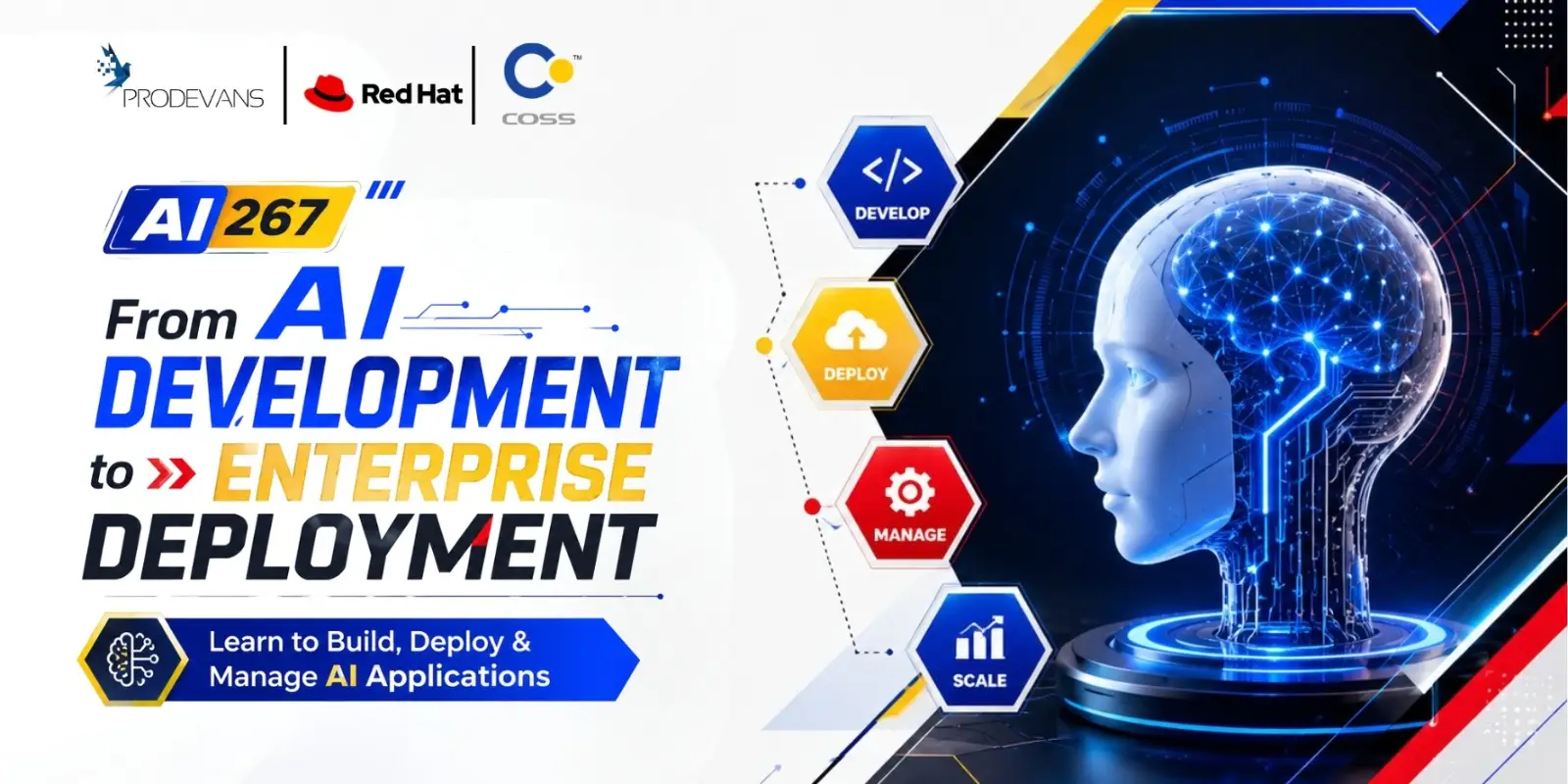
AI is moving quickly, but learning AI isn’t just about understanding models anymore.
For professionals already working in software development, data science, cloud, DevOps, or machine learning, the next challenge is often much more practical: how do you take an AI application from development to a production environment?
That means working with model deployment, serving, monitoring, pipelines, automation, and the infrastructure required to support AI workloads at scale.
This is where AI267 — Developing and Deploying AI/ML Applications on Red Hat OpenShift AI comes in.
The official Red Hat course is designed to help learners develop the skills required to manage the complete lifecycle of modern AI applications, covering predictive AI as well as generative AI. The current curriculum is based on Red Hat OpenShift 4.20 and Red Hat OpenShift AI 3.3.
For professionals looking to move beyond AI experimentation and develop practical enterprise AI skills, AI267 offers a focused learning path built around development, deployment, monitoring, and operationalisation.
What Does AI267 Cover?
AI267 is structured around the practical stages involved in taking AI/ML applications through their lifecycle.
Rather than spending the course simply discussing AI concepts, learners work with the tools and workflows used to develop and manage AI applications.
The current Red Hat curriculum covers:
- OpenShift AI and its MLOps and GenAIOps capabilities
- AI/ML development workbenches
- Model serving
- Predictive AI model deployment
- AI model monitoring
- AI pipelines
- Advanced Kubeflow Pipelines development
- Generative AI model optimisation and evaluation
- Building GenAI applications
That combination makes AI267 particularly relevant for professionals who want to understand what happens after an AI model has been developed.
What Will You Learn in AI267?
1. Work with AI/ML Development Workbenches
The course introduces workbench environments used for AI/ML development and shows learners how to connect these environments with data sources and storage.
This provides a structured environment for experimentation and development while supporting collaboration across data science teams.
2. Understand Model Serving
A trained model needs to be made available to an application before it can deliver value.
AI267 covers how to prepare, deploy, and serve models using OpenShift AI’s model-serving capabilities.
3. Deploy Predictive AI Models
Learners also gain practical exposure to deploying predictive AI models using specialised runtimes such as OpenVINO.
This gives participants experience with the deployment side of machine learning rather than stopping at model development.
4. Monitor AI Models
AI applications don’t simply get deployed and forgotten.
AI267 covers monitoring deployed models for factors including bias, data drift, and performance, using tools such as TrustyAI and observability capabilities.
This is particularly important for professionals working with AI applications in production environments.
5. Build AI Pipelines
As AI workflows become more complex, automation becomes increasingly important.
The course introduces AI pipelines and advanced Kubeflow Pipelines development, helping learners understand how data science workflows can be structured and automated.
6. Work with Generative AI
AI267 also moves beyond traditional predictive machine learning.
The current curriculum includes Generative AI model optimisation and evaluation, followed by the development of GenAI applications.
This gives the course relevance for professionals looking to work across both traditional ML and newer GenAI workloads.
The Skills You’ll Take Away
By the end of AI267, learners should be able to work with several important areas of modern AI application development, including:
1. AI/ML Development
Develop and work with AI/ML applications within OpenShift AI environments.
2. Model Deployment & Serving
Prepare, deploy, and serve AI models for applications.
3. MLOps Workflows
Understand how automation, pipelines, monitoring, and lifecycle management fit into AI operations.
4. Model Monitoring
Track model performance and identify issues such as bias and data drift.
5. AI Pipelines
Build and experiment with automated data science workflows.
6. Generative AI
Explore GenAI model optimisation, evaluation, and application development.
7. Enterprise AI Workflows
Understand how these components come together to ensure AI applications operate reliably at scale.
Who Is AI267 Designed For?
AI267 is not positioned as a beginner’s introduction to artificial intelligence.
Red Hat identifies ML Engineers working with MLOps/LLMOps responsibilities and Data Scientists who train, deploy, and track their own models as the primary audiences for the course.
It can also be relevant to professionals working in adjacent areas, including:
- AI/ML Engineering
- MLOps
- Software Development
- DevOps
- Cloud Engineering
- Platform Engineering
- OpenShift
- Data Science
However, there are some prerequisites worth considering before enrolling.
Red Hat recommends a basic understanding of machine learning principles and workflows, Generative AI and LLMs, as well as experience with Git and Python development. Experience with Red Hat OpenShift is also recommended.
COSSINDIA’s current course page also lists basic Linux knowledge, basic Kubernetes concepts, and Python programming as recommended prerequisites.
In simple terms:
AI267 is best suited to someone who already has a technical foundation and now wants to add enterprise AI application development and operational skills to it.
What Makes AI267 Different from a General AI Course?
There are plenty of courses that teach machine learning.
There are also plenty that teach Generative AI.
AI267 takes a different approach.
Its focus is on the practical workflow around AI applications:
Develop → Train → Test → Deploy → Serve → Monitor → Optimize
That makes it particularly relevant for professionals who don’t just want to understand AI models but want to understand how those models are handled in a production environment.
For someone already working in development, cloud, DevOps, or data science, this can be an important next layer of technical expertise.
Hands-On Learning With COSSINDIA
COSSINDIA’s current AI267 offering is built around practical learning rather than theory alone.
The course page highlights instructor-led live sessions, real-time labs, enterprise AI projects, mock assessments, certification-oriented training, flexible batch timings, and one-year lab access.
The listed projects and lab activities include areas such as:
- AI model deployment on OpenShift
- Machine learning pipeline automation
- AI model monitoring
- MLOps CI/CD pipelines
- Containerised ML applications
- Enterprise AI application deployment
- GPU-based AI workloads
This practical component is important because AI skills become much more useful when you can apply them rather than simply describe them.
Where Can AI267 Take You?
AI267 can form part of a broader career path for professionals moving toward enterprise AI and MLOps.
A possible progression could look like:
Linux & Infrastructure Fundamentals
↓
Containers & Kubernetes
↓
OpenShift
↓
AI267 — Developing & Deploying AI/ML Applications
↓
MLOps / AI Engineering
↓
Enterprise AI Platform Engineering
COSSINDIA currently presents a similar progression on its AI267 learning path, moving from Linux Administration and containers/Kubernetes through OpenShift AI and into MLOps and enterprise AI roles.
The important point is that AI267 doesn’t have to be viewed as an isolated certification course. For the right learner, it can become a bridge between existing infrastructure and development skills and the growing field of enterprise AI.
AI267 and the EX267 Certification
For learners who want to take their OpenShift AI skills further, AI267 connects with the Red Hat Certified Developer in AI (EX267) certification.
The EX267 exam evaluates practical skills around configuring and managing OpenShift AI, including working with data science projects, workbenches, data connections, machine learning models, model serving, and data science pipelines.
Importantly, EX267 is a performance-based exam. Candidates demonstrate their skills by completing practical tasks rather than simply answering theoretical questions.
That makes the learning journey particularly relevant for professionals who want to validate their ability to work with OpenShift AI in practical environments.
Why Consider AI267 Now?
The value of AI skills isn’t limited to knowing how to build a model.
As organisations move more AI applications into real-world environments, professionals need to understand what happens around the model—deployment, serving, monitoring, automation, pipelines, and application development.
AI267 focuses precisely on that layer.
It brings together AI/ML, MLOps, Generative AI, Kubernetes-based infrastructure, OpenShift, and application deployment into one structured learning experience.
For professionals who already have a foundation in AI, development, Linux, Kubernetes, or cloud technologies, that combination can make AI267 a useful next step in building enterprise AI expertise.
Build Your Next AI Skillset with AI267
AI is moving quickly, but the fundamentals of building reliable applications still matter.
The professionals who can connect AI development with deployment, automation, monitoring, and production environments will play an increasingly important role as organizations scale their AI initiatives.
AI267 — Developing and Deploying AI/ML Applications on Red Hat OpenShift AI is designed for professionals who want to develop exactly those skills.
With the official Red Hat curriculum, practical learning, hands-on labs, and a pathway toward the EX267 Red Hat Certified Developer in AI certification, AI267 offers a focused route for professionals ready to take their AI expertise beyond experimentation.
Ready to take the next step? Explore AI267 training with COSSINDIA and start building practical skills for the enterprise AI landscape.