
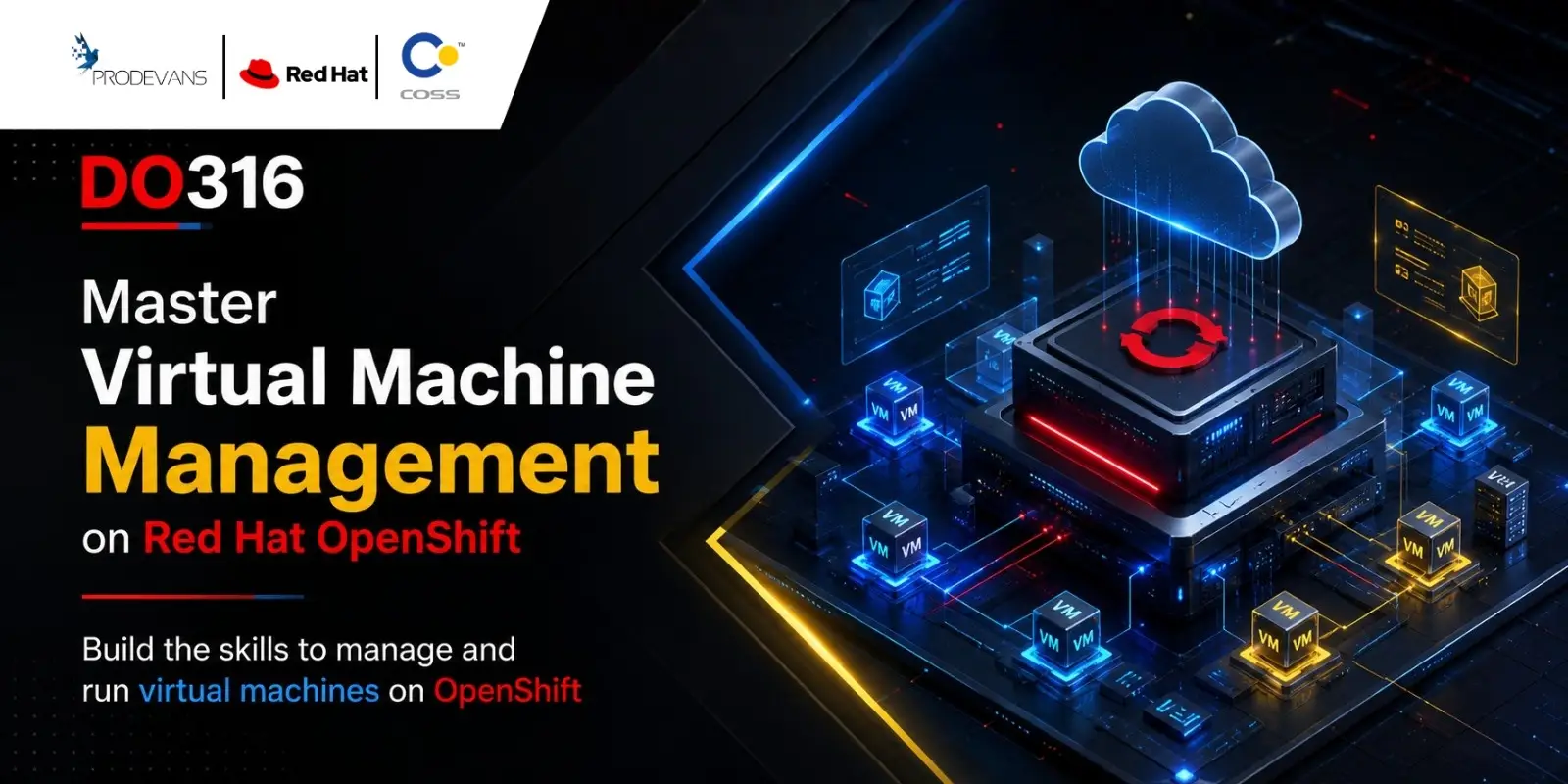
Virtual machines aren’t disappearing just because enterprises are moving toward Kubernetes and cloud-native infrastructure.
In fact, many organisations are dealing with both at the same time. They have existing applications running on virtual machines, while newer workloads are being developed around containers, Kubernetes, and cloud-native platforms.
The challenge is no longer simply choosing between virtualisation and containers. It’s learning how to manage both efficiently within a modern infrastructure environment.
That’s where Red Hat OpenShift Virtualisation comes in—and where DO316: Red Hat OpenShift Virtualisation Administration Rapid Track becomes relevant for IT professionals looking to expand their infrastructure skills.
What Is DO316?
DO316 is an accelerated Red Hat training course focused on creating, managing, and supporting production-ready virtual machines using Red Hat OpenShift Virtualisation.
The course combines essential content from DO156: Red Hat OpenShift Virtualisation Administration I and DO256: Red Hat OpenShift Virtualisation Administration II, giving experienced OpenShift professionals a more focused route into virtualisation administration. The current course is based on Red Hat OpenShift Virtualisation 4.18.
The focus is practical: learners develop the skills required to manage virtual machines and their supporting Kubernetes and OpenShift resources in production environments.
What Will You Learn in DO316?
DO316 covers the key areas an administrator needs to understand when working with virtual machines on OpenShift.
1. Deploy and Configure OpenShift Virtualisation
The course begins with deploying the OpenShift Virtualisation Operator and understanding the configuration required to prepare an OpenShift environment for virtual machine workloads.
2. Create and Manage Virtual Machines
Learners work with the complete VM lifecycle, including creating, configuring, managing, and monitoring virtual machines within OpenShift.
3. Manage VM Networking
The course covers networking for virtual machines, helping administrators understand how VMs connect to other workloads and external networks within an OpenShift environment.
4. Manage VM Storage
Storage is a critical part of virtualisation. DO316 covers persistent storage, snapshots, virtual machine images, cloning and importing or exporting VM images.
5. Configure High Availability
Production workloads cannot simply stop whenever infrastructure encounters a failure or requires maintenance. DO316 teaches learners how to configure virtual machines for high availability and resilience during failures, planned maintenance, and cluster upgrades.
6. Manage Workload Placement
Learners also explore how Kubernetes resources can be used to control where virtual machines run within the cluster and how workloads can be rebalanced across nodes.
Why Are OpenShift Virtualisation Skills Important?
Enterprise infrastructure is changing, but it’s not changing overnight.
Organisations still have applications that depend on virtual machines. At the same time, they are adopting Kubernetes and containerised workloads for newer applications.
OpenShift Virtualisation provides a way to bring these two worlds together by allowing virtual machines to run alongside container workloads within an OpenShift environment. Red Hat describes this as a way to manage virtualised and containerised workloads using the same orchestration and clustering infrastructure.
This creates opportunities for professionals who understand both traditional virtualisation and modern cloud-native infrastructure. For someone already working with VMware, Linux, Kubernetes, OpenShift, or cloud infrastructure, learning OpenShift Virtualisation can therefore be a natural extension of existing skills rather than a completely new career direction.
Who Should Consider DO316?
DO316 is not designed as a beginner-level introduction to OpenShift.
Because it is an accelerated course, Red Hat requires learners to have DO180 or equivalent OpenShift administration skills, including experience using the OpenShift web console and command-line interface. Red Hat also recommends Linux administration experience.
The course is particularly relevant for:
- Virtual Machine Administrators
- OpenShift Administrators
- Kubernetes Administrators
- Platform Engineers
- Cloud Administrators
- Cloud Engineers
- System Administrators
- Infrastructure Engineers
- Virtualisation professionals looking to modernise their skill set
It can also be particularly useful for professionals managing traditional virtualisation environments who want to understand how their existing VM workloads can fit into a Kubernetes-based infrastructure.
From Traditional Virtualisation to OpenShift Virtualisation
For a virtualisation administrator, one of the most interesting aspects of OpenShift Virtualisation is workload migration.
Organisations often have years of applications and infrastructure invested in traditional virtualisation platforms. Moving those workloads to a new environment requires more than simply creating new virtual machines.
It involves understanding storage, networking, compatibility, workload requirements, and migration processes.
OpenShift Virtualization includes tools and capabilities for bringing existing VM workloads into OpenShift, while Red Hat also provides the Migration Toolkit for Virtualisation to support migration scenarios.
For professionals already familiar with virtualisation, this makes DO316 particularly relevant to the broader conversation around infrastructure modernisation.
What Practical Skills Can You Build?
The value of DO316 goes beyond learning individual features.
Through the course, learners develop skills around:
- OpenShift Virtualisation administration
- Virtual machine lifecycle management
- VM networking
- Persistent storage
- VM snapshots and images
- Workload placement
- High availability
- Kubernetes resources
- Enterprise virtualisation
- VM migration
These skills can help professionals work more confidently in environments where virtualised and containerised workloads need to coexist.
Learning DO316 With COSSINDIA
For a technical course like DO316, practical experience matters.
COSSINDIA’s DO316 training focuses on helping learners apply OpenShift Virtualisation concepts through hands-on learning and enterprise-oriented scenarios.
Rather than simply understanding what a virtual machine is, learners can work through areas such as VM administration, networking, storage, migration, high availability, and production environment management.
That practical approach is important because virtualisation administration is ultimately about managing real workloads—not just understanding the terminology.
Knowing how to create a VM is one thing. Knowing how to keep that VM running reliably in a production environment is another.
DO316 and the EX316 Certification
For professionals looking to validate their OpenShift Virtualisation skills, DO316 connects with the EX316: Red Hat Certified Specialist in OpenShift Virtualisation certification.
The EX316 exam evaluates practical skills around planning, deploying, and managing virtual machines using the Red Hat OpenShift Virtualisation Operator in an OpenShift environment.
The learning path can therefore look like:
OpenShift Administration
↓
DO316 – OpenShift Virtualisation Administration Rapid Track
↓
EX316 – Red Hat Certified Specialist in OpenShift Virtualisation
For the right professional, this provides an opportunity to build on existing OpenShift knowledge and develop a specialised virtualisation skill set.
Why Consider DO316 Now?
The future of enterprise infrastructure isn’t necessarily about replacing everything that came before it.
It’s about finding better ways to manage what already exists while creating room for what’s next.
Virtual machines remain important to enterprise IT, while Kubernetes and cloud-native platforms continue to expand. Professionals who understand how these environments can work together are increasingly valuable to organizations modernizing their infrastructure.
DO316 brings these two areas together.
For OpenShift administrators, virtualisation professionals, cloud engineers, and infrastructure specialists, it offers a focused path to develop practical skills in managing virtual machines on OpenShift.
With hands-on training through COSSINDIA and a pathway toward the EX316 Red Hat Certified Specialist in OpenShift Virtualisation certification, DO316 can be a strong next step for professionals looking to expand their enterprise infrastructure expertise.
Explore DO316 training with COSSINDIA and build the skills to manage the next generation of enterprise virtualisation.