
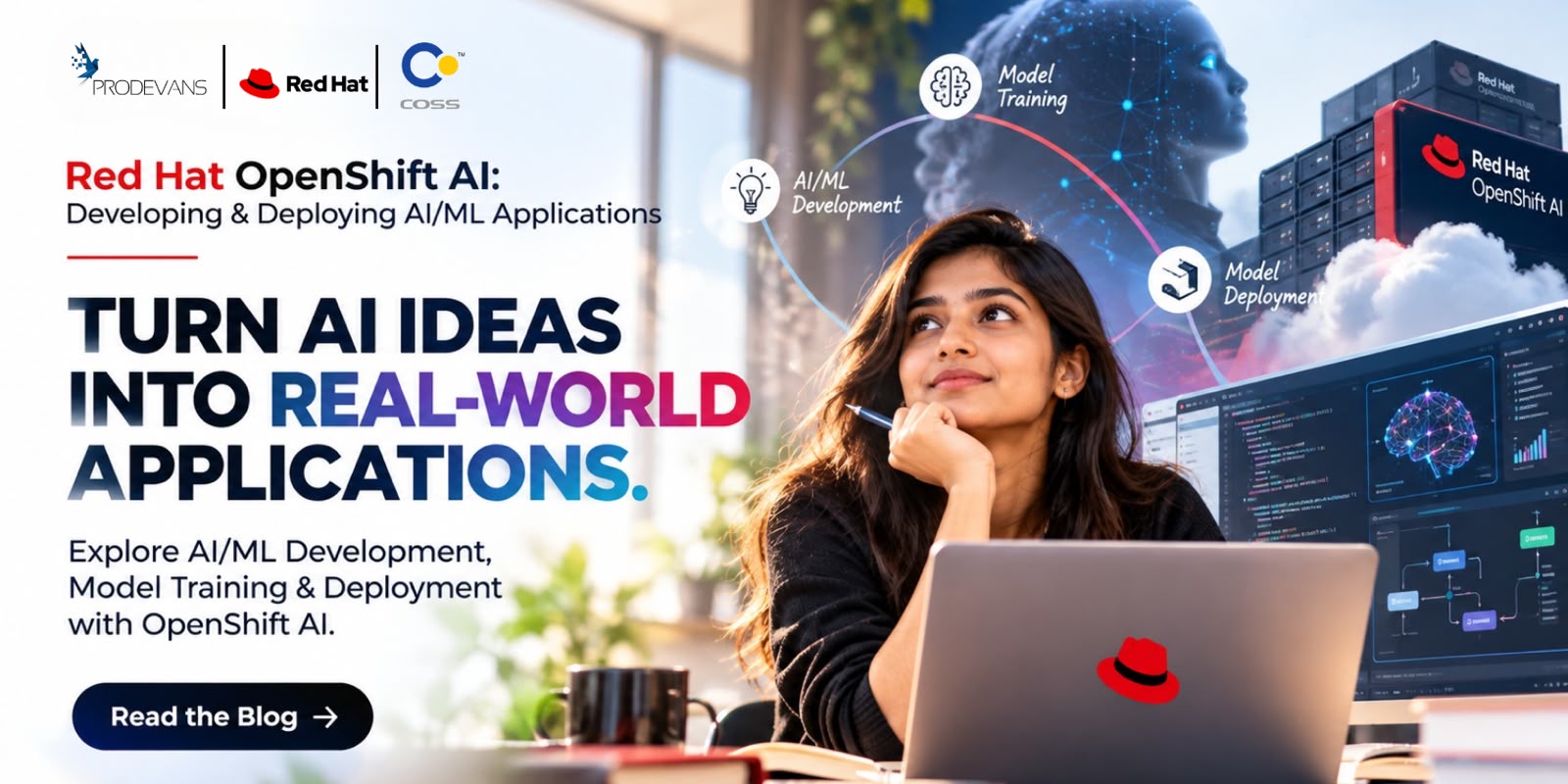
AI has moved well beyond experimentation.
Companies are now building machine learning models, generative AI applications, recommendation systems, forecasting tools and intelligent automation into real products. But building a model is only one part of the job. The bigger challenge is getting that model into production, keeping it reliable, monitoring its performance and managing the infrastructure around it.
That is where Red Hat OpenShift AI comes into the picture.
For developers, data scientists and ML engineers, OpenShift AI provides a platform for working across the AI/ML lifecycle — from development and training to deployment, monitoring and automation. The AI267: Developing and Deploying AI/ML Applications on Red Hat OpenShift AI course is designed to build these practical skills.
The current AI267 course is based on Red Hat OpenShift 4.20 and Red Hat OpenShift AI 3.3.
What Is Red Hat OpenShift AI?
Red Hat OpenShift AI is a platform for developing, deploying and managing AI and machine learning applications on OpenShift.
The important part is that it is not focused only on training a model.
A real AI application usually involves several steps:
Data → Development → Training → Testing → Deployment → Monitoring → Improvement
OpenShift AI brings many of these activities together so teams can work with models and AI applications in a more structured, repeatable environment.
It supports both predictive AI and generative AI, while providing capabilities around MLOps and GenAIOps.
For an organisation, this matters because moving an AI project from a notebook to a production environment can involve infrastructure, resources, model serving, pipelines, monitoring and collaboration.
OpenShift AI is designed to help manage that journey.
Why Does the AI/ML Lifecycle Matter?
Imagine a data scientist has trained a model that predicts customer demand.
The model works well in testing.
But what happens next?
Someone needs to deploy it. Applications need a way to access it. The model needs appropriate compute resources. Its performance needs to be monitored. The underlying data may change over time. Eventually, the model may need to be retrained.
This is why modern AI roles increasingly extend beyond simply knowing machine learning algorithms.
Professionals also need to understand how models are operationalised.
That is the space where concepts such as MLOps, model serving, AI pipelines, monitoring and automation become important.
Developing AI/ML Applications with OpenShift AI
One of the core areas of OpenShift AI is providing environments where developers and data scientists can actually build AI/ML solutions.
AI267 introduces workbenches, which provide environments for AI/ML development and can connect to required data sources and stores.
This is useful when multiple people are working on AI projects and need a consistent environment rather than everyone maintaining completely different local setups.
For example, a data scientist might use a workbench to develop and test a machine learning model while working with shared project resources.
The environment can then become part of a broader workflow rather than remaining an isolated experiment on one developer’s machine.
Training and Testing Models
Model development doesn’t stop when the code runs successfully.
Models need to be trained using data, evaluated and tested before they can be considered ready for deployment.
OpenShift AI provides capabilities that support this process while working within the OpenShift environment.
The AI267 course covers the development lifecycle for both predictive AI models and generative AI models, helping learners understand how these models can move from development into operational environments.
This distinction is important.
A machine learning model sitting inside a notebook may demonstrate that an idea works.
A production AI application needs a repeatable process around that model.
Model Serving: Taking AI Into Production
One of the biggest jumps in an AI project is moving from a trained model to a model that applications can actually use.
This is where model serving comes in.
OpenShift AI provides model-serving capabilities for deploying and serving models. AI267 covers the fundamentals of model serving as well as serving predictive AI models using specific runtimes.
Think of it this way:
A trained model is an asset.
Model serving makes that asset available to an application.
For example, an organisation could have a trained model that predicts whether a transaction is likely to be fraudulent. Once deployed through an appropriate serving environment, an application can send data to the model and receive a prediction.
The technical details can become complex at scale, which is why understanding deployment and serving is becoming an important skill for ML engineers and developers.
Monitoring AI Models After Deployment
Deployment isn’t the finish line.
A model that performs well today may behave differently tomorrow.
The data going into the model can change. Performance can decline. Bias can emerge. Infrastructure problems can affect availability.
OpenShift AI includes capabilities for monitoring AI models, including the use of TrustyAI and observability tools to monitor areas such as bias, data drift and model performance.
This creates an important shift in thinking:
AI isn’t something you build once and forget.
It needs to be observed and managed throughout its lifecycle.
For professionals working in MLOps, this operational side of AI is particularly important.
AI Pipelines and Automation
Another challenge appears when AI workflows become repetitive.
Imagine having to manually perform the same sequence every time a model is updated:
- Collect data
- Prepare the data
- Train the model
- Test it
- Evaluate the results
- Deploy it
- Monitor it
Doing this manually doesn’t scale very well.
AI pipelines help turn these steps into repeatable workflows.
AI267 introduces AI pipelines and covers advanced development using Kubeflow Pipelines, including container components, artifact management, Kubernetes configuration and experimentation.
For organisations building multiple AI applications, automation can make the difference between a workflow that works for one project and a workflow that can be repeated across many projects.
Where Does Generative AI Fit?
Generative AI has changed what organisations expect from AI platforms.
Instead of only building predictive models, teams are now working with large language models and applications involving technologies such as retrieval-augmented generation (RAG) and agentic workflows.
OpenShift AI extends into this area as well.
The current AI267 course includes GenAI model optimisation and evaluation, along with building GenAI applications using production-oriented patterns such as RAG and agentic workflows.
The important point isn’t simply knowing how to interact with an LLM.
Enterprise GenAI involves questions around:
- How do we deploy the model?
- How do we evaluate its performance?
- How do we connect it to organisational data?
- How do we monitor it?
- How do we manage resources?
- How do we build appropriate safeguards?
These are engineering and operational questions — not just AI theory.
OpenShift AI Use Cases
The platform can be relevant across a wide range of AI/ML applications.
Predictive analytics
Organisations can deploy models used for forecasting, classification, recommendation and other predictive workloads.
Customer intelligence
AI models can help analyse customer behaviour, identify patterns and support personalised experiences.
Fraud and risk detection
Machine learning models can analyse transactions and other signals to identify potentially unusual activity.
Generative AI applications
Teams can develop applications using large language models, RAG and other GenAI patterns.
Automated decision support
AI models can assist teams by analysing large amounts of information and generating predictions or insights.
The exact application depends on the organisation, its data and its business requirements. OpenShift AI provides the underlying environment for developing and operationalising these workloads.
Who Should Learn OpenShift AI?
OpenShift AI isn’t necessarily a starting point for someone who has never encountered AI, Python or OpenShift.
Red Hat currently recommends familiarity with machine learning principles, Generative AI/LLMs, Git and Python, along with experience using OpenShift or completion of an equivalent OpenShift developer course.
The course is particularly relevant to:
- ML Engineers working with MLOps/LLMOps
- Data Scientists deploying and tracking models
- Developers building AI-powered applications
- DevOps and platform professionals moving into AI infrastructure
- Technical professionals working with OpenShift and cloud-native technologies
For someone already working with Linux, Kubernetes, OpenShift, Python or DevOps, OpenShift AI can be a natural extension into AI/ML infrastructure.
What Does AI267 Teach?
The AI267 curriculum covers the major stages of the AI application lifecycle.
Key areas include:
- Introduction to Red Hat OpenShift AI
- AI/ML development using workbenches
- Model serving fundamentals
- Predictive AI model deployment
- AI model monitoring
- AI pipelines
- Advanced Kubeflow Pipelines development
- GenAI model optimisation and evaluation
- Building GenAI applications
The associated EX267 Red Hat Certified Developer in AI certification validates skills around deploying and configuring OpenShift AI, working with data science projects and workbenches, configuring data connections, deploying models and creating data science pipelines.
The EX267 exam is performance-based, meaning candidates are evaluated through practical tasks rather than simply answering theoretical questions.
Why OpenShift AI Skills Matter for IT Professionals
AI is creating a new layer of technical work.
There are data scientists who build models.
There are developers who build applications around those models.
There are platform engineers who provide the infrastructure.
There are ML engineers who help operationalise and monitor the entire lifecycle.
And increasingly, these areas overlap.
That makes skills around AI + cloud-native infrastructure + automation particularly useful for professionals who want to move beyond traditional development or administration roles.
OpenShift AI sits at that intersection.
It combines AI/ML workflows with the OpenShift ecosystem, giving professionals a way to understand not just how AI models are created, but how they can be managed in an enterprise environment.
Building a Career Around OpenShift AI
Learning OpenShift AI doesn’t mean abandoning the fundamentals.
In fact, the strongest learning path can be built by connecting them.
The exact path will depend on your existing background.
For example, someone coming from a Linux administration background may first need stronger OpenShift and Python skills.
A developer may already have Python and application development experience but need to strengthen Kubernetes and OpenShift.
A data scientist may understand machine learning well but need more exposure to deployment, pipelines and infrastructure.
The value comes from connecting these skills rather than treating AI as an isolated subject.
who already have a foundation in OpenShift, Python, Git and AI/ML concepts, it can be a logical next step toward MLOps, GenAIOps and AI application development.
Frequently Asked Questions
1. What is Red Hat OpenShift AI?
Red Hat OpenShift AI is a platform for developing, deploying and managing AI/ML applications on OpenShift. It supports workflows across predictive AI and generative AI, including development, model serving, pipelines and monitoring.
2. What is AI267?
AI267 is Red Hat’s Developing and Deploying AI/ML Applications on Red Hat OpenShift AI course. The current version is based on Red Hat OpenShift 4.20 and OpenShift AI 3.3.
3. Is AI267 suitable for beginners?
AI267 is better suited to learners who already have some background in machine learning, Generative AI, Git, Python and OpenShift. Red Hat lists these as recommended prerequisites or equivalent experience.
4. What is EX267?
EX267 is the Red Hat Certified Developer in AI exam associated with AI267. It tests practical skills in configuring and managing OpenShift AI and working with AI/ML models and applications.
5. What career roles can benefit from OpenShift AI skills?
OpenShift AI can be relevant to ML Engineers, Data Scientists, Developers, DevOps professionals, platform engineers and technical professionals working with AI/ML infrastructure.
6. Does OpenShift AI support Generative AI?
Yes. The current AI267 curriculum includes GenAI model optimisation and evaluation and building GenAI applications using patterns such as RAG and agentic workflows.