
A few years ago, building an AI model required specialised expertise, expensive infrastructure, and months of experimentation.
Today, things look very different.
With open-source frameworks, pre-trained models, and Generative AI tools becoming widely accessible, creating an AI application has become significantly easier. But here’s the reality many organisations discover after the excitement of building a successful prototype:
An AI model has little business value until it can be deployed, monitored, and scaled in production.
That’s where many AI initiatives begin to slow down.
Questions such as: How do we deploy this securely? How do we manage multiple models? How do we monitor performance over time? and how do development and data science teams collaborate efficiently? become far more important than the model itself.
This is exactly why platforms like Red Hat OpenShift AI are gaining attention across enterprise IT. They help organisations bridge the gap between experimentation and production, enabling teams to build, deploy, and manage AI applications in a structured, scalable way.
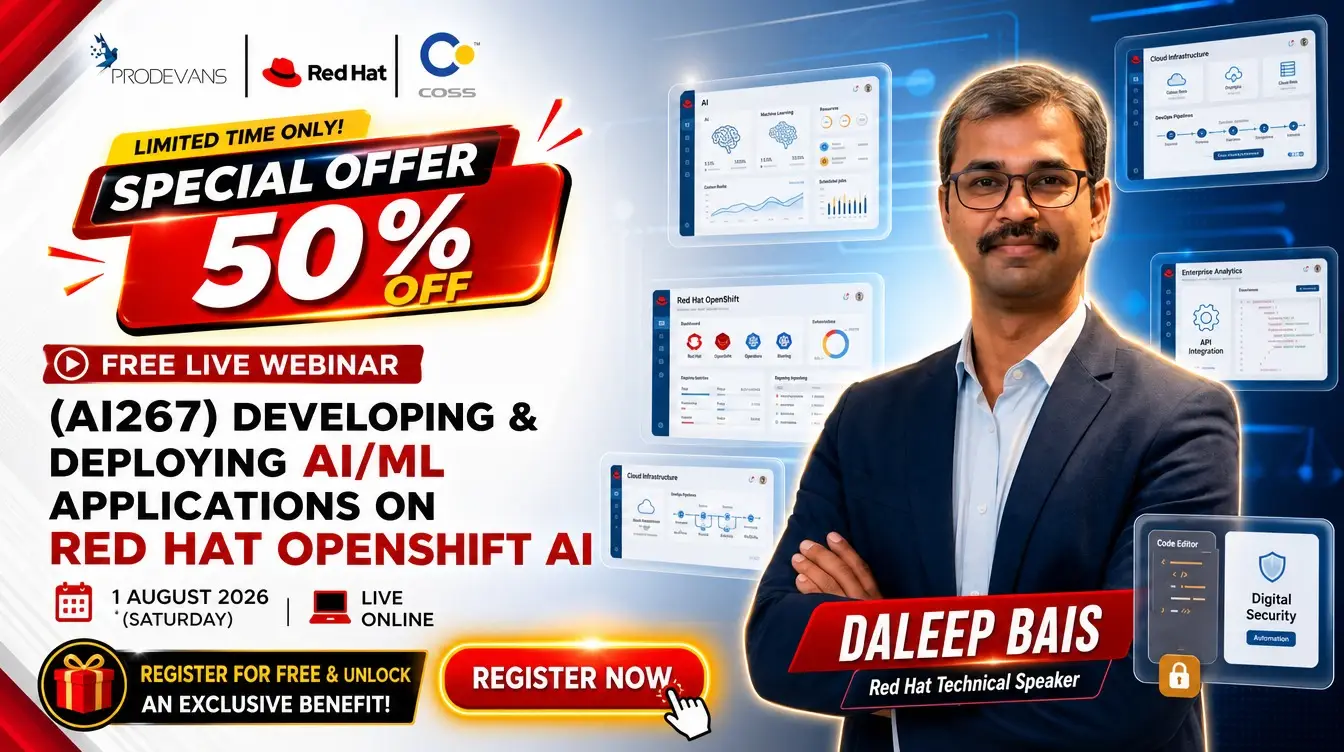
To help developers and IT professionals understand this evolving landscape, COSSINDIA is hosting a live webinar on 1st August focused on one of Red Hat’s latest enterprise AI learning programs:
Developing & Deploying AI/ML Applications on Red Hat OpenShift AI (AI267)
Rather than introducing AI concepts at a high level, this webinar explores how enterprise AI applications are developed, deployed, and managed using Red Hat OpenShift AI.
Enterprise AI Isn’t Just About Building Models
Ask almost any AI professional what takes the most time in a real-world project, and the answer usually isn’t model development.
It’s everything that comes after.
Deploying models into production.
Managing different versions.
Scaling workloads.
Monitoring performance.
Ensuring security.
Integrating with existing applications.
These challenges become even more complex as organisations move from experimenting with AI to running business-critical workloads.
Red Hat OpenShift AI is designed to simplify this process by providing a platform where developers, data scientists, and operations teams can work together throughout the AI lifecycle.
Instead of stitching together multiple tools, organisations can manage AI development, deployment, monitoring, and collaboration within a unified environment built on Kubernetes and cloud-native technologies.
What Is AI267?
Developing & Deploying AI/ML Applications on Red Hat OpenShift AI (AI267) is an official Red Hat course that focuses on the practical side of enterprise AI.
Rather than teaching learners how to build another machine learning model from scratch, the course explores what happens after a model is ready.
Participants learn how to:
- Develop AI-enabled applications
- Work with Red Hat OpenShift AI workbenches
- Deploy and serve machine learning models
- Understand MLOps workflows
- Build AI pipelines
- Optimize Generative AI models
- Manage AI applications on Kubernetes
The emphasis is on practical implementation—helping learners understand how AI solutions are developed and maintained in enterprise environments.
Why This Conversation Matters Now
AI adoption is accelerating across industries.
Banks are using AI to detect fraud.
Healthcare organizations are supporting clinical decisions with machine learning.
Manufacturers are improving predictive maintenance.
Retailers are personalizing customer experiences.
Yet, despite this momentum, one challenge remains common across sectors:
Moving AI projects from proof-of-concept to production.
Professionals who understand this transition and the technologies that make it possible are becoming increasingly valuable.
That makes learning platforms such as Red Hat OpenShift AI relevant not only for AI specialists but also for developers, cloud engineers, DevOps professionals, and platform teams responsible for running modern applications.
Learn from an Industry Expert
The webinar will be led by Daleep Singh Bais, an industry professional from Red Hat with over 12 years of broad technical and training experience in Linux and open-source technologies.
Having worked extensively with enterprise technologies and technical training, Daleep brings practical perspectives that extend beyond documentation and classroom theory.
During the session, he’ll discuss how organisations are approaching AI application development using Red Hat OpenShift AI, the challenges teams commonly encounter, and the practices that help transform AI experiments into production-ready solutions.
For attendees, it’s an opportunity to hear directly from someone working closely with the technologies shaping today’s enterprise AI landscape.
Where This Webinar Can Add Value
Not every technical session needs to be attended by everyone.
This webinar will be especially useful for professionals who are beginning to explore enterprise AI or are looking to understand how AI fits into modern cloud-native environments.
You may find this session valuable if you are:
- A Software Developer building intelligent applications
- An AI or Machine Learning Engineer interested in production deployment
- A DevOps or MLOps Engineer working with automation and infrastructure
- A Cloud or Platform Engineer managing Kubernetes environments
- An OpenShift Administrator expanding into AI workloads
- An IT professional planning to upskill in enterprise technologies
- A student interested in understanding how enterprise AI differs from academic machine learning
Even if you’re not actively working on AI today, understanding how organizations deploy and manage AI applications provides valuable context for where enterprise technology is heading.
Why Learn Through COSSINDIA?
Learning technology is one thing.
Learning how it’s actually used in enterprise environments is another.
As an Authorized Red Hat Training Partner, COSSINDIA focuses on bridging that gap through official Red Hat training, hands-on learning, and guidance aligned with industry practices.
Learners benefit from:
- Official Red Hat curriculum
- Practical, lab-based learning
- Expert-led instruction
- Certification guidance
- Structured learning paths
- Skills aligned with enterprise environments
The AI267 course reflects this philosophy by helping learners understand not only the technology itself but also how it is applied in real-world AI projects.
The Future of Enterprise AI Starts with Practical Skills
The conversation around AI is no longer limited to building smarter models.
Increasingly, it’s about building systems that are reliable, scalable, secure, and ready for production.
As organisations continue investing in AI and cloud-native technologies, professionals who understand platforms like Red Hat OpenShift AI will be better prepared to contribute to enterprise AI initiatives.
If you’re curious about how AI applications are developed beyond the prototype stage—or you’re exploring the intersection of AI, Kubernetes, MLOps, and cloud-native development—this webinar offers an excellent opportunity to learn directly from an experienced Red Hat professional.
📅 Date: 1st August
🎙 Speaker: Daleep Singh Bais, Industry Professional, Red Hat
💻 Topic: Developing & Deploying AI/ML Applications on Red Hat OpenShift AI (AI267)
Join the session to explore how enterprise AI is moving from experimentation to production—and what skills are becoming increasingly important in that journey.