
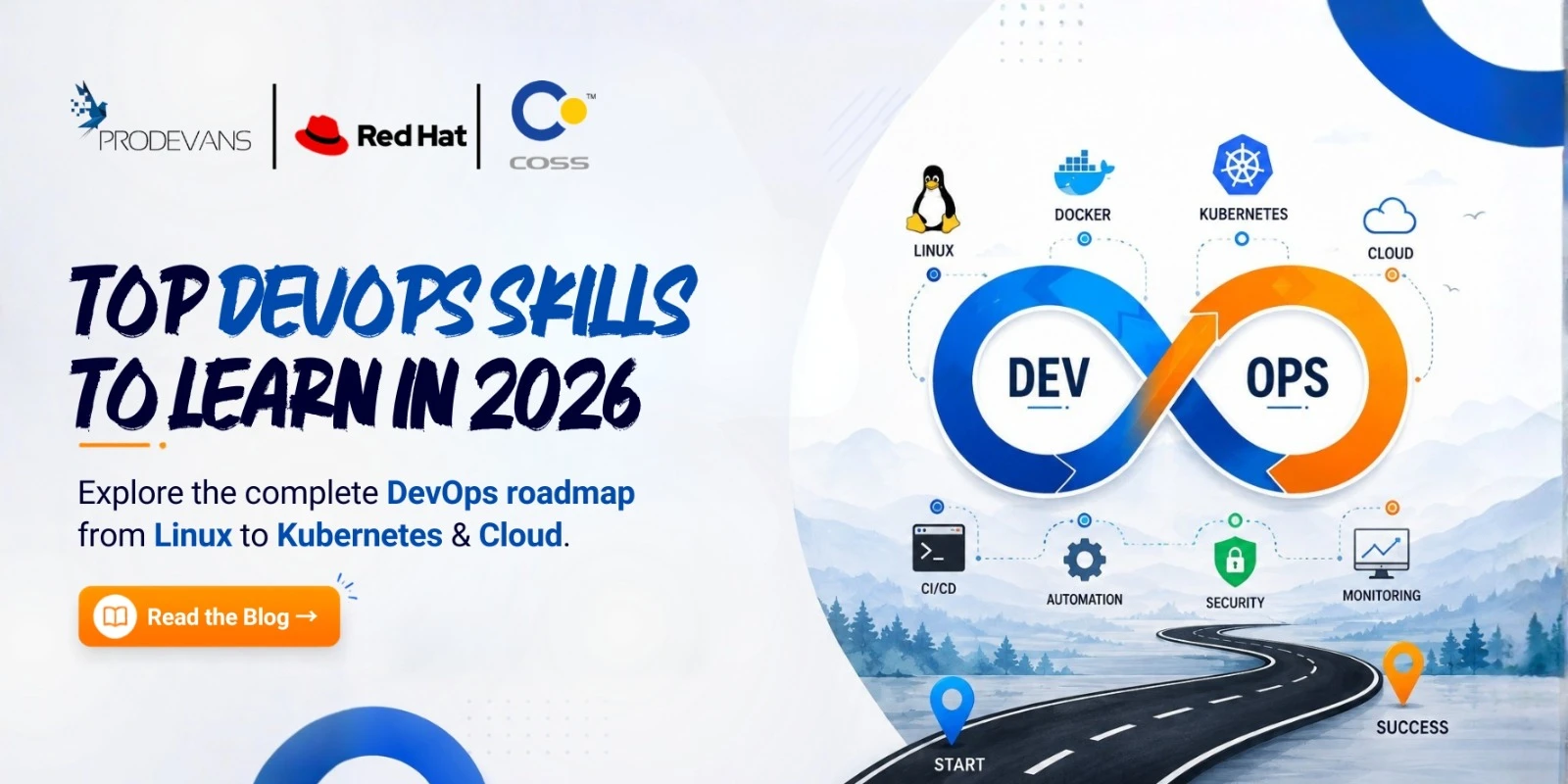
DevOps has changed.
Not long ago, knowing Linux administration, writing shell scripts, and managing servers could give you a strong starting point for a DevOps role. Those skills still matter, but modern DevOps has grown far beyond basic system administration.
Today, DevOps sits at the intersection of development, infrastructure, automation, cloud, containers, security, and monitoring. Professionals may be expected to work with Git, build CI/CD pipelines, manage containers, deploy applications on Kubernetes, provision infrastructure with Terraform, and monitor systems running in the cloud.
That can make choosing where to start confusing.
The good news is that you don’t need to learn everything at once. The better approach is to understand how the technologies fit together and build your skills progressively.
So, if you’re planning your DevOps roadmap for 2026, these are the technologies and skills worth prioritising.
How Has DevOps Evolved?
The basic idea behind DevOps is still the same: bringing development and operations closer together so software can be delivered faster and more reliably.
What’s changed is the scale and complexity of modern applications.
A typical workflow might now look something like:
Code → Version Control → Build → Test → Containerise → Deploy → Monitor
Each stage requires different tools and skills.
Linux remains the foundation, but professionals now need to understand the technologies that connect infrastructure, applications, and automation.
1. Linux: The Foundation of DevOps
If you’re serious about learning DevOps, don’t skip Linux.
Cloud workloads, containers, Kubernetes environments, and many enterprise applications ultimately depend on Linux. Understanding Linux also makes troubleshooting much easier when something goes wrong further up the stack.
Key areas to learn include:
- Linux commands and file systems
- Users, groups, and permissions
- Processes and services
- Networking
- Package management
- Shell scripting
- SSH
- System logs and troubleshooting
Navigating and troubleshooting a Linux environment.
Linux is still one of the most important DevOps skills to build in 2026.
2. Git: Learn Version Control
Once you have a Linux foundation, Git should be one of your next priorities.
Git allows teams to track changes, collaborate on code, manage branches, and maintain different versions of projects.
For DevOps professionals, Git is particularly important because infrastructure configurations, application code, Dockerfiles, Kubernetes manifests, and CI/CD definitions can all be managed through version control.
Start with:
Repositories, Commits, Branches, Merging, Pull requests, Remote repositories, Conflict resolution
Git may seem simple compared with Kubernetes or Terraform, but you’ll use it constantly.
3.Docker: Understand Containers
Traditional deployments often involve configuring applications directly on servers. Containers provide a more consistent way to package applications and their dependencies.
That’s where Docker comes in.
A good understanding of Docker should include:
- Images
- Containers
- Dockerfiles
- Registries
- Volumes
- Networks
- Container lifecycle
- Docker Compose
Don’t focus only on memorising commands. Understand why containers exist and how they change application deployment.
This knowledge also provides the foundation for learning Kubernetes.
4. Kubernetes: A Core DevOps Skill
Knowing how to run one container is useful. Managing hundreds of containers is a different challenge.
That’s where Kubernetes comes in.
Kubernetes provides orchestration for containerised applications and can handle scheduling, scaling, service discovery, rolling deployments, and maintaining the desired state of workloads.
For anyone building a DevOps roadmap in 2026, Kubernetes deserves significant attention.
Start with:
Pods, Deployments, Services, ConfigMaps, Secrets, Namespaces, Ingress, Persistent storage, Resource management
Once the fundamentals are clear, you can move into areas such as Helm, operators, security, and cluster administration.
5. CI/CD: Automate Software Delivery
Imagine a developer pushes code to Git.
What happens next?
Someone could manually build the application, run tests, package it, deploy it, and check whether everything works.
DevOps aims to automate much of this process through CI/CD—Continuous Integration and Continuous Delivery or Deployment.
Tools you may encounter include:
Jenkins, GitHub Actions, GitLab CI/CD, Tekton, Argo CD
The specific tool matters less than understanding the workflow:
Code → Build → Test → Package → Deploy → Validate
Once you understand this process, learning different CI/CD platforms becomes much easier.
6. Terraform: Infrastructure as Code
Modern infrastructure isn’t always created manually through a cloud console.
With Infrastructure as Code (IaC), infrastructure can be defined and managed through configuration files.
Terraform is one of the most widely used tools for this approach.
Important concepts include:
Providers, Resources, Variables, Outputs, Modules, State, Plan and Apply
Terraform becomes particularly powerful when combined with cloud platforms and CI/CD, allowing teams to create consistent and repeatable infrastructure
7. AWS and Azure: Build Cloud Skills
Modern DevOps and cloud computing are closely connected.
Platforms such as AWS and Microsoft Azure provide the infrastructure and managed services behind many modern applications.
You don’t need to learn every cloud service.
Start with:
- Compute
- Storage
- Networking
- Identity and access management
- Databases
- Containers
- Load balancing
- Monitoring
If you’re starting, choose one cloud platform and build deeper knowledge there rather than trying to master AWS and Azure simultaneously.
Master one. Understand the other.
8. Monitoring and Observability
Deployment isn’t the end of the job.
You also need to know whether an application is working—and understand why it isn’t when something goes wrong.
That’s where monitoring and observability become important.
Tools commonly used in this space include:
- Prometheus
- Grafana
- OpenTelemetry
- Elasticsearch
- Cloud-native monitoring platforms
A useful way to understand observability is through three areas:
Metrics — What’s happening?
Logs — What happened?
Traces — Where did the request go?
As applications become more distributed across Kubernetes and cloud environments, these skills become increasingly important.
How Do These DevOps Skills Fit Together?
This is perhaps the most important part of learning DevOps.
Don’t think of these technologies as completely separate subjects. Think of them as different layers of the same workflow.
Linux → Foundation
Git → Version control
Docker → Containerisation
Kubernetes → Container orchestration
CI/CD → Automated delivery
Terraform → Infrastructure automation
AWS/Azure → Cloud infrastructure
Monitoring → Visibility and reliability
What About DevOps Certifications?
Certifications can help validate your knowledge and make your profile more competitive, particularly when you’re starting or moving into a new technical area.
Depending on your career goals, you can explore certifications around:
- Linux
- Kubernetes
- Cloud platforms
- Terraform
- DevOps
- Red Hat technologies
But certification shouldn’t replace practical experience.
A certificate can demonstrate that you’ve learned something.
Being able to troubleshoot a failed deployment is what demonstrates that you can use it.
That’s why good DevOps courses should combine structured learning with hands-on labs and practical projects.Is DevOps Still a Good Career in 2026?
Yes—but the role continues to evolve.
DevOps professionals increasingly work across infrastructure, automation, cloud, containers, security, and application delivery.
The strongest candidates aren’t necessarily the ones who know the largest number of tools.
They’re the ones who understand how those tools work together to solve an operational problem.
So instead of asking:
“Which DevOps tool should I learn first?”
Ask:
“What problem does this technology solve, and what comes next in the workflow?”
That’s a much better way to build a DevOps career in India or anywhere else.
Frequently Asked Questions:
What are the most important DevOps skills to learn in 2026?
The key DevOps skills for 2026 include Linux, Git, Docker, Kubernetes, CI/CD, Infrastructure as Code with Terraform, cloud platforms such as AWS and Azure, and monitoring and observability. Understanding how these technologies work together is more important than simply learning individual tools.
Is Linux still important for DevOps?
Yes. Linux remains a fundamental DevOps skill because many cloud workloads, containers, Kubernetes environments, and enterprise applications run on Linux. Strong Linux knowledge also helps professionals troubleshoot infrastructure and application issues more effectively.
Should I learn Docker before Kubernetes?
Yes, it is generally useful to understand container fundamentals before learning Kubernetes. Docker helps you understand images, containers, registries, networking, and container lifecycles, while Kubernetes builds on those concepts to orchestrate containerised applications.
Which cloud platform should I learn for DevOps: AWS or Azure?
Both AWS and Azure are valuable for DevOps professionals. If you’re starting out, it can be more effective to develop deeper knowledge of one platform rather than trying to learn both simultaneously. Once you understand core cloud concepts, moving between platforms becomes easier.
Is Kubernetes necessary for a DevOps career?
Kubernetes has become an important skill for professionals working with modern containerised and cloud-native environments. You don’t necessarily need to master advanced Kubernetes immediately, but understanding concepts such as Pods, Deployments, Services, ConfigMaps, Secrets, Ingress, and persistent storage provides a strong foundation.
Are DevOps certifications worth it?
DevOps certifications can help validate your knowledge and strengthen your professional profile, particularly when you’re starting or moving into a new technical area. However, certifications should complement practical experience rather than replace it. Hands-on labs and real projects are important for developing the ability to troubleshoot and manage real environments.
How long does it take to learn DevOps?
There isn’t a fixed timeline because it depends on your existing IT knowledge and the depth of skills you’re trying to develop. Someone with Linux and networking experience may progress faster than someone starting from scratch. A structured approach- Linux and Git first, followed by Docker, Kubernetes, CI/CD, Terraform, cloud, and monitoring- can make the learning process more manageable.
Is DevOps a good career in India in 2026?
DevOps continues to be a relevant career path as organisations rely increasingly on cloud infrastructure, automation, containers, and modern application delivery. Professionals who can connect development, infrastructure, automation, cloud, and monitoring can pursue roles across DevOps and related areas.
SEO tip: These FAQs naturally target long-tail searches around DevOps skills 2026, DevOps courses, Kubernetes and Docker, DevOps certification, AWS DevOps, Azure DevOps, and DevOps career in India without stuffing the keywords unnaturally. The existing SEO package already covers those primary and secondary terms.
Building Your DevOps Skills in 2026
DevOps can look overwhelming when you first encounter the list of technologies: Linux, Git, Docker, Kubernetes, Jenkins, Terraform, AWS, Azure, Prometheus, and many more.
But you don’t need to master everything at once.
Start with the fundamentals. Build something. Break it. Fix it. Automate it. Deploy it. Monitor it.
Then add the next layer.
Because modern DevOps isn’t really about knowing a collection of tools.
It’s about understanding the journey from code to a reliable production system.
And that’s the skill set worth building in 2026.